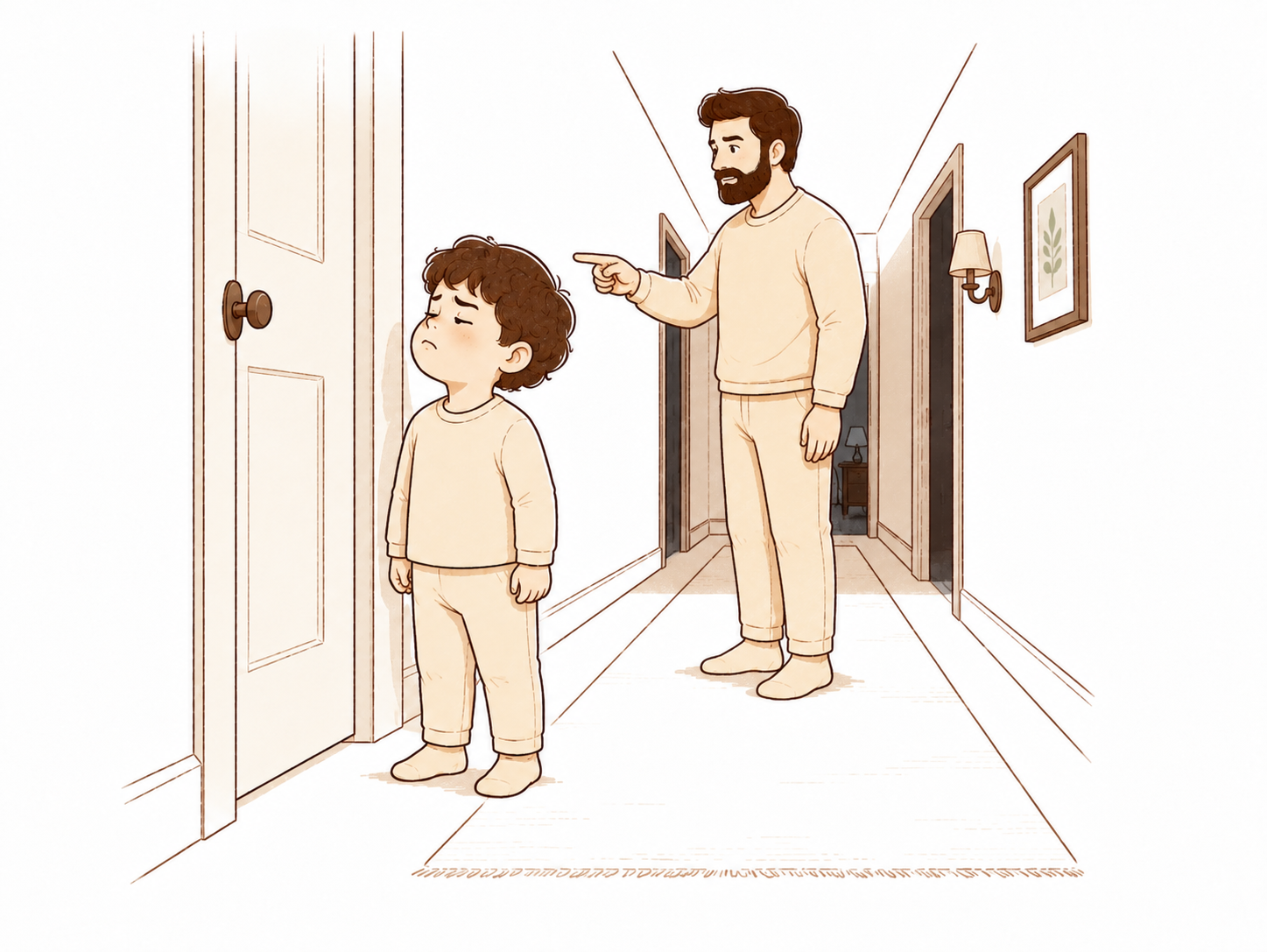
The clock says 8:30PM. You have already said goodnight twice. You can hear them. They are not asleep.
Bedtime resistance is one of the most-searched parenting problems for a reason. It repeats every night, at the end of the day when you have the least left, because the child has learned the pattern: protest, delay, get a parent back, repeat.
Your child does not need less sleep. Bedtime has become a negotiation, and negotiations have no fixed end point.
What works is a wind-down sequence that lowers arousal before the limit lands, a clear goodbye script, and a plan for the loop that follows.
Contents
- Why bedtime resistance happens
- The 4-step bedtime protocol
- What to say at bedtime
- What to do if it fails
- The parent habit to build
Why bedtime resistance happens
Bedtime layers three hard things on top of each other at the same moment.
The first is a transition. The child is leaving the day, losing access to you, and switching from high-activity to stillness. Transitions are hard for most children. Transitions at the end of a depleted day are harder.
The second is arousal. A child who came straight from a screen, a sibling conflict, or a rushed dinner has a nervous system that hasn't come down yet. The 20 minutes before lights out determine how long the battle lasts. A kid who's already calm fights less when you say goodnight.
The third is the learned loop. Some children test the bedtime limit because they've found it produces more parent contact. Every extra trip to the bedroom, every glass of water, is information: the limit moves. Once a child knows the limit moves, they test it every night.
Most bedtime resistance is all three at once.
The 4-step bedtime protocol
Step 1: Wind-down window (20 minutes before lights out)
End screens and lower the lights first, before anything else. This is not the time for hard conversations, unresolved conflicts, or new demands. One goal: bring arousal down.
If the evening was difficult, the wind-down window matters more, not less. Start it on time even if the house is still loud. A child who had 20 minutes of dim lights and quiet will resist less than the same child who went straight from chaos to lights out.
Step 2: The same sequence every night
Bath or wash, pajamas, brush teeth, one story, lights out. The sequence is not flexible. When it is the same every night, the child's nervous system begins anticipating sleep before you say goodnight. The routine is the signal. If you skip steps or reorder them under time pressure, expect more resistance.
Step 3: Clear limit at lights out
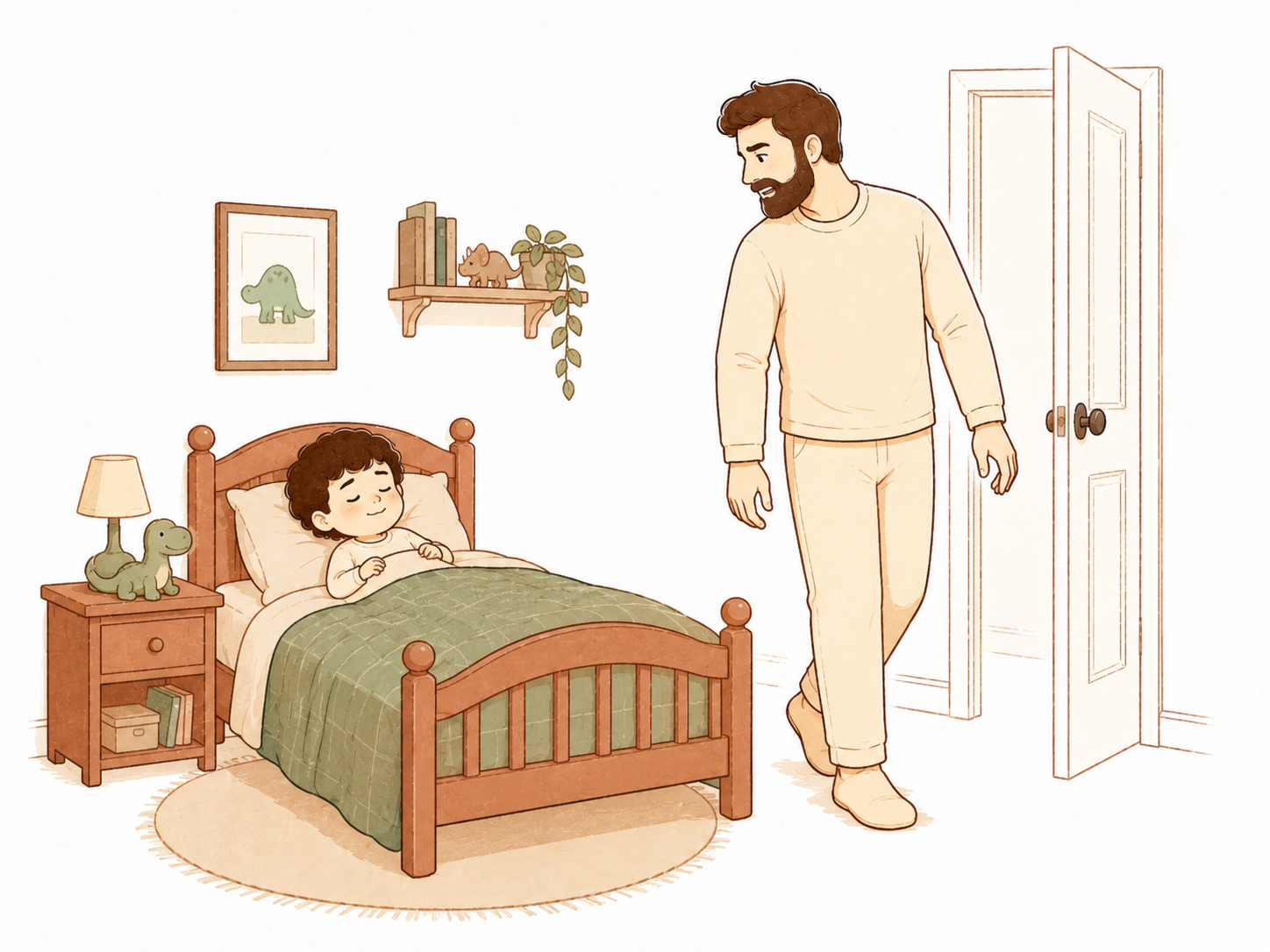
One goodnight. One sentence. Then you leave.
Do not negotiate after this point. Every response to a call-out, even a short "I already said goodnight," resets the expectation. The child has learned: if I call, a parent comes. The response teaches the behavior.
Step 4: Hold the limit
The first few nights of holding a fixed bedtime limit are the hardest. The protests get louder before they stop. That's not the protocol failing. That's your kid checking if you mean it. Hold it. The test ends faster than the protest suggests it will.
What to say at bedtime
| Situation | Don't say | Say instead |
|---|---|---|
| "I'm not tired" | "Yes you are, it's late". | "Your job is to lie quietly. You don't have to be asleep yet". |
| "I need water" | "Fine, one more glass". | "There's water on your nightstand. I love you. Goodnight". |
| "I'm scared" | "There's nothing to be scared of". | "I hear you. I'm right down the hall. You are safe". |
| "One more story" | "Okay, just one more". | "Stories are done. We read our story. Goodnight". |
| "I need you" | "I just came in three times". | "I know. I love you. I'll see you in the morning". |
| Keeps calling out | Respond and explain again | Walk in, say nothing or one word, walk out |
Keep every response short. Warmth without reopening the loop.
What to do if it fails
If they keep getting out of bed:
Walk them back without discussion or a lecture. One sentence: "Back to your room". Do this as many times as it takes. The first night may take eight trips. The second night, four. The third night, two. The test ends when the child learns the limit is real. The first nights get louder because the old loop is checking whether it still works. That is normal. It is temporary. The parent's job is to outlast it calmly.
If they escalate to a full meltdown in the hallway:
They cannot cooperate right now. Shift from limit-holding to regulation support. Get low, stay calm, say one thing: "I'm here. When you're ready, I'll walk you back". Do not raise your voice. Do not restart the conversation about bedtime rules. Wait for the body to settle, then walk them back quietly.
If the child won't move and is lying on the floor:
Say once, calmly: "I'm going to carry you to your room now". Then do it. Carry them, settle them in bed, say goodnight, and leave. The physical follow-through holds the limit without turning it into punishment.
If it is still not working after two weeks:
Something else is going on. Bedtime resistance that doesn't respond to a consistent routine often comes from one of these:
- Anxiety: fear of the dark or of separation.
- Co-parent inconsistency: one parent holds the limit, one doesn't.
- A sleep drive problem: naps too late, or bedtime too early or too late for the child's biology.
The protocol addresses the behavioral loop. If the behavioral loop isn't the whole problem, the protocol alone won't close it. This is when to look at what changed, when it started, and whether professional support makes sense.
Who this protocol is not for:
Children whose bedtime resistance is driven by significant separation anxiety, sensory differences, neurodevelopmental needs, trauma, or a medical sleep condition. This gets most kids there. If it doesn't, that's a different conversation, not a bigger protocol.
The parent habit to build
Implementation intention: When the clock shows [bedtime minus 20 minutes], I start the wind-down sequence. Even if the evening is still loud. Even if I'm mid-conversation.
The most common reason bedtime protocols fail is that the wind-down window gets eaten by the evening. Dinner runs late. There's a conflict that needs resolving. The temptation is to sort everything first, then start bedtime. Don't. Start on schedule. An unsettled child who had 20 minutes of dim lights will resist less than a settled child who went straight from chaos to lights out.
One miss is fine. Two becomes the pattern: If last night was chaos, tonight just do Step 1 on time. Lower the lights at the right time and hold that one thing. You don't have to nail the full sequence on the second attempt. Running one step consistently beats running four steps inconsistently.
Ready to install this, not just read it?
The Bedtime Reset applies the Transitions and Anxiety mechanisms to the full bedtime loop: the wind-down sequence, the separation fear conversation, co-parent consistency rules, and a 7-day protocol for resetting a bedtime routine that has broken down over months.
The article tells you what to do. The Reset installs it.
Join the waitlist for the Bedtime Reset →