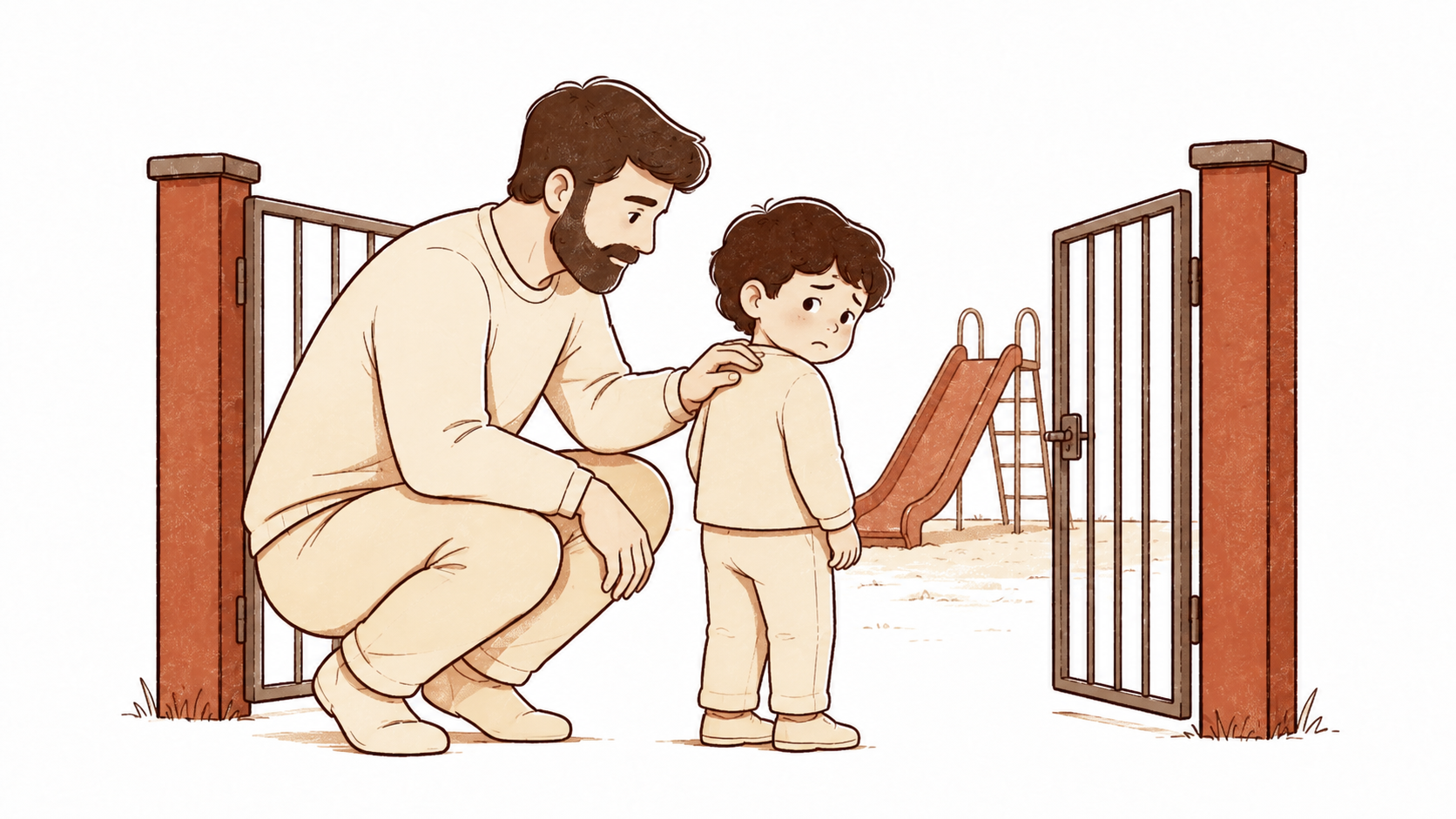
A transition asks a child to stop, remember what comes next, shift their attention, and tolerate the loss of what they were doing. All at the same time.
That is 4 demands at once. Their brain is still holding the slide, the snack, your voice, and the car, all in the same small window.
The screaming at the park exit is not defiance. It is a capacity problem hitting 4 simultaneous demands.
Think of a transition like a bridge. The child has to leave one state and arrive at another, and they need an on-ramp to get there.
In this article
Why transitions fail
A child has to hold the plan in mind, stop what they are doing, shift their attention to what comes next, and know when "now" actually is. Researchers group these skills under one name: executive function.
In adults, these work automatically. In children, they develop gradually. A typical 3-year-old has meaningful working memory for 1 to 2 steps. A typical 5-year-old is still building the ability to stop a rewarding activity on instruction.
A verbal warning 5 minutes before leaving asks for all 4 skills at once. The child must hold the time information, stop the current play, shift attention to the coming event, and tolerate the anticipatory loss. Most children cannot do that with words alone. Words are abstract, and a brain still building these skills cannot always turn them into action.
Transitions require the nervous system to move from one state to another. That is biologically taxing. Tovah Klein's work in How Toddlers Thrive identifies transitions as the highest-stress moment in a toddler's day. Not because the child is difficult. Because the biology of state change is genuinely hard.
Knowing this changes the protocol: instead of hunting for better words, you lower the demand the leaving puts on your child's brain.
The Turn Law for this moment: choice inside the boundary.
The 4-step transition protocol
Run these in order. Each step reduces one of the 4 executive function demands.
Step 1: Pre-announce (5 to 10 minutes before)
This step just gives the brain a runway to start moving, no agreement required yet.
One neutral announcement, once: "We leave the park in 10 minutes".
Do not make it conditional, attach a consequence to it, or count down every 2 minutes. One announcement gives the brain time to begin the state change without triggering resistance.
Step 2: Make the next step visible (2 minutes before)
Tell them what comes right after, not what comes eventually.
"After we leave, we get in the car and drive home. Then snack".
Not: "We have to go home and you need bath and then bed". That is 3 future demands. The brain cannot hold 3 future demands while managing a current loss.
One next step. If possible, make it concrete and desirable.
Step 3: Give a bounded choice (1 minute before)
A choice reduces the experience of control loss. It shifts the question from "do I have to go" to "how do I go".
"Do you want to walk or do you want me to carry you to the car?"
Both options lead to the same outcome. The choice is real. The destination is not negotiable.
Where they end up is fixed. How they get there is theirs to pick.
Do not ask: "Are you ready to go?" That is a yes/no question where yes is compliance and no is a negotiation you have already lost.
Step 4: Brief goodbye ritual (at the moment of leaving)
Name what they are leaving, not what they are going to.
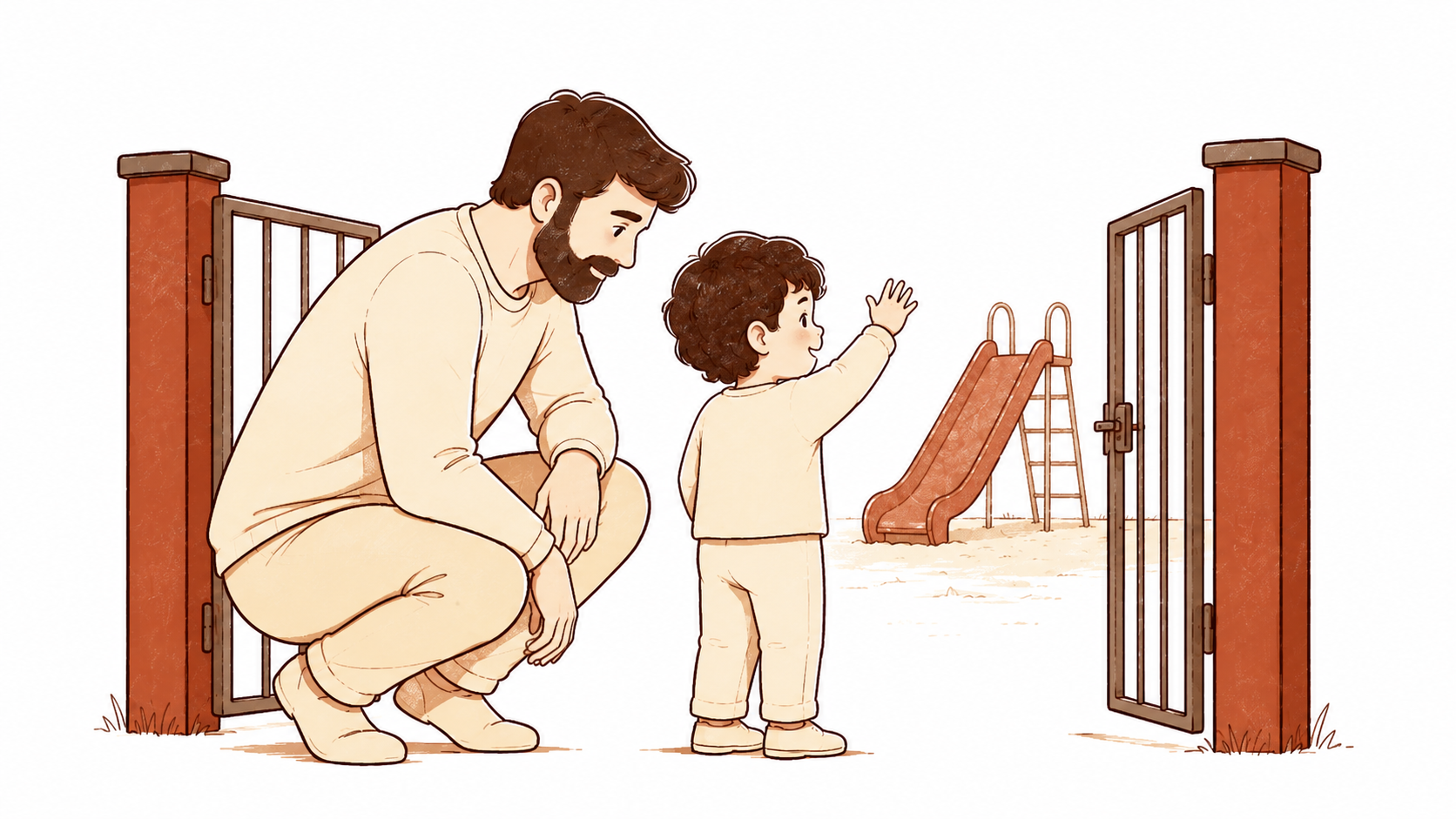
"Say bye to the slide".
A named goodbye gives the brain a completion signal. The ritual closes the current state so the brain can open the next one. Tovah Klein calls this the transitional bridge.
Do not skip this step when you are in a hurry. Skipping the goodbye is what produces the screaming 30 seconds later.
Scripts for common transitions
| Transition | Pre-announce | Make next visible | Choice | Goodbye ritual |
|---|---|---|---|---|
| Leaving the park | "10 minutes, then we go". | "After park: car, then snack". | "Walk or carry to the car?" | "Say bye to the slide". |
| Ending screen time | "Show ends in 5 minutes". | "After this: dinner, then you pick the book". | "Pause it yourself or should I?" | "Wave bye to the show". |
| School morning | "10 minutes to the door". | "After drop-off I go to work. I am there at 3". | "Walk to the door or race me?" | "One hug at the door". |
| Bedtime | "15 minutes to pajamas". | "Bath, 2 books, lights out". | "Which pajamas?" | "Say goodnight to the room". |
What to do if it fails
The protocol fails 2 ways.
You run every step and still get escalation. That is normal for the first 5 to 7 days. The child's brain is learning to predict the pattern, and prediction is what reduces resistance. The more reliable the pattern gets, the less they fight it.
The reason it works is mechanical: your child can predict what comes next, so their brain is not managing uncertainty on top of the transition itself. Run the same protocol at the same transitions for at least 7 days before you decide it does not work. The more times they hear it, the more they trust it is coming.
The child escalates to full meltdown every time, even after 7 days. That pattern points at something below the surface: sleep debt, hunger going into the transition, anxiety about what comes after, or a specific sensory profile. Map the pattern for 5 days. Log the trigger, the transition, the outcome. The pattern tells you which variable to address.
You are already late. That is not the moment to teach flexibility, manners, or why leaving matters. Move the transition with the least friction available. Teach later, outside the pressure cooker.
You ran every step and the child is on the floor and will not move. Say once: "I am going to carry you to the car". Pick them up. Say the goodbye ritual while they are in your arms: "Say bye to the slide". Moving while held is still completing the transition. Most children shift once their feet are off the ground. Do not read the crying as proof the protocol failed. The transition was hard, and this is what hard looks like while it finishes.
The parent habit to build
Transition protocols work because of repetition. The hardest part is running the first step, the pre-announcement, consistently.
The habit to build: set a 10-minute alarm on your phone for every transition you run more than 3 days per week. When the alarm fires, deliver the announcement. One sentence. Done.
Implementation intention: "When my phone alarm fires for [transition], I say '[child's name], [time] more minutes, then [next step].' Once. Then I continue what I was doing".
One miss is fine. Two becomes the pattern. If you skip the pre-announcement on a hard morning, run it the next day. The transition gets easier in proportion to how consistently you announce it, not how perfectly you ran it once.
The Transitions Reset
This article is the protocol. The Transitions Reset installs it: rehearsal scripts for the 4 steps across your highest-friction transitions, variant-specific troubleshooting for screen-time and bedtime, and a co-parent sync sheet.
The Foundation
This is article 3 of 6 in The Foundation, the complete parent regulation toolkit.
- The conversation that prevents the meltdown: Pre-empt it before it starts
- The meltdown protocol: What to say in the first 60 seconds
- You are here. The transition protocol: why every leaving is hard and the 4-step fix
- What to do when your child won't listen: The defiance protocol
- What to do after you lose it: The repair protocol
- The 9 rules underneath every protocol: The Turn Laws
Next: What to do when your child won't listen →
In the wild: Screen time transitions · Morning routine resistance · School refusal at drop-off · Mealtime power struggles