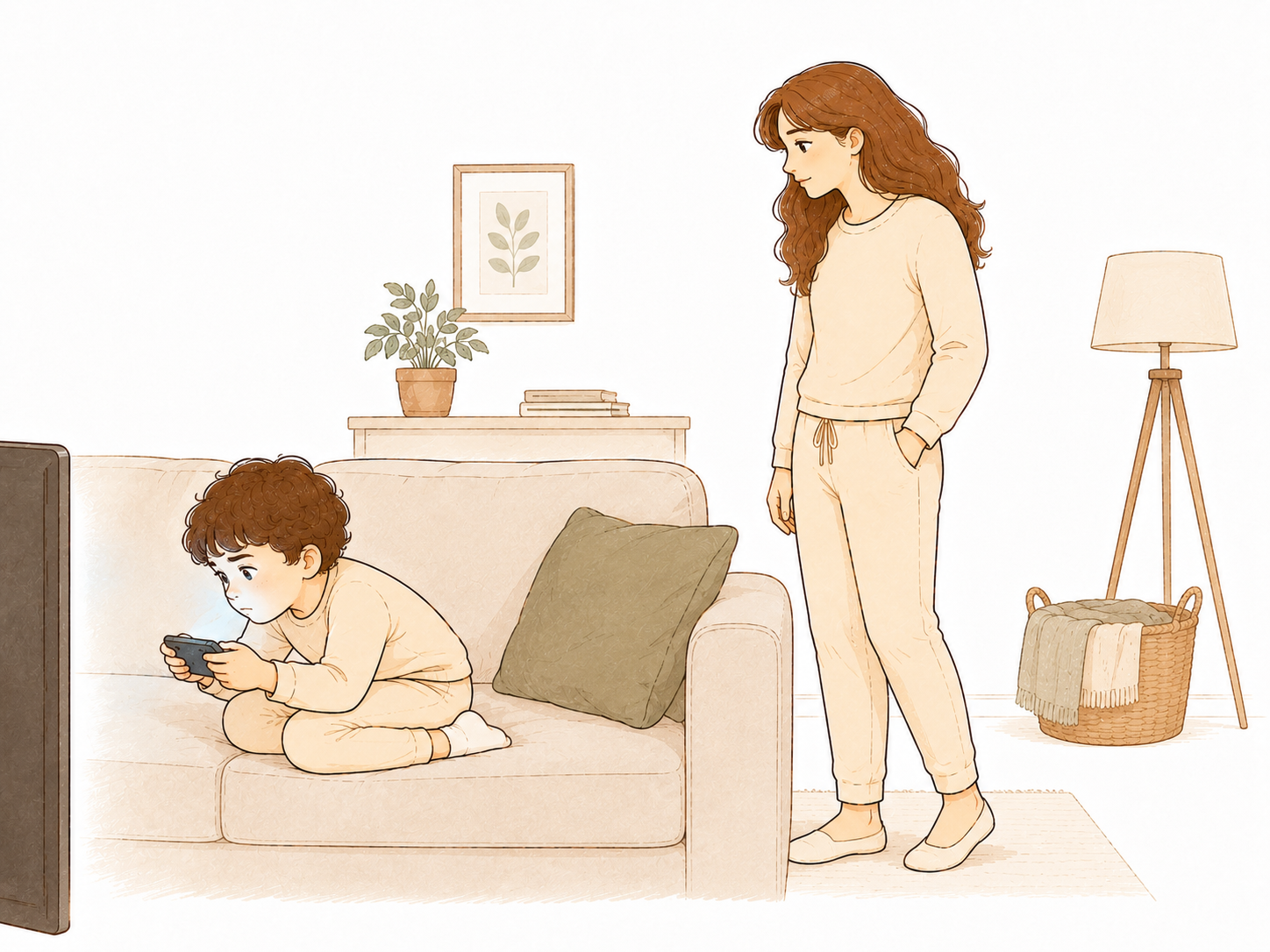
The show ends. Or you say it's time. The screen goes dark and your child's body goes somewhere else entirely.
Screen transitions are one of the most common and most searched parenting flashpoints. They happen every day, they feel disproportionate, and the standard approach of warnings, countdowns, and negotiation often makes it worse.
This is not a willpower problem, and it is not defiance. Screens are hard to leave because they are leaving the show, the screen world, and the promise of one more episode at the same time. The transition protocol for screens starts before you say a word.
Contents
- Why screen transitions are so hard
- The 5-step screen transition protocol
- What to say when screen time ends
- What to do if it fails
- The parent habit to build
Why screen transitions are so hard
Screens are not uniquely addictive. They are uniquely engaging, holding a still body while the brain stays inside the show, in a room that has effectively disappeared around an unfinished story.
When you say "turn it off," you're asking them to drop the story, come back into the room, and do something more boring. All at once. Most adults find this hard. Most children find it very hard.
The warning system fails when it becomes background noise. A child who has heard "five more minutes" fifty times has learned that "five more minutes" means nothing has changed yet. The warning only works if there is a consistent, concrete endpoint it is pointing toward.
The bigger structural issue: if the end of screens is unpredictable, ending sometimes at one episode, sometimes three, sometimes when a parent gets frustrated, your kid never knows when it's actually ending, so they fight every time just in case.
The 5-step screen transition protocol
Step 1: Set the container before the screen starts
Tell the child how many episodes or how many minutes before the screen goes on. Not after. "We are watching one episode, then we are having dinner". The container is set at the beginning, not announced at the end.
This step is the one most parents skip. We skip it too. When we forget to set the container before the screen goes on, the transition at the other end is always harder.
Step 2: Give a real warning, not a countdown
Five minutes before the end: "One more minute of this episode, then screens are done". Name the specific stopping point: not a duration, but the actual event. "When this episode ends" is clearer than "in five minutes".
Two minutes before: lower your voice, reduce stimulation in the room. Turn on a light. Reduce background noise. The transition starts before the screen goes off.
Step 3: Name what comes next
Children resist transitions partly because the next thing is unknown. "Screens are done" lands harder than "screens are done and dinner is on the table". Name the next activity specifically. Make it concrete and, if possible, make it something the child wants.
Step 4: Choice inside the boundary
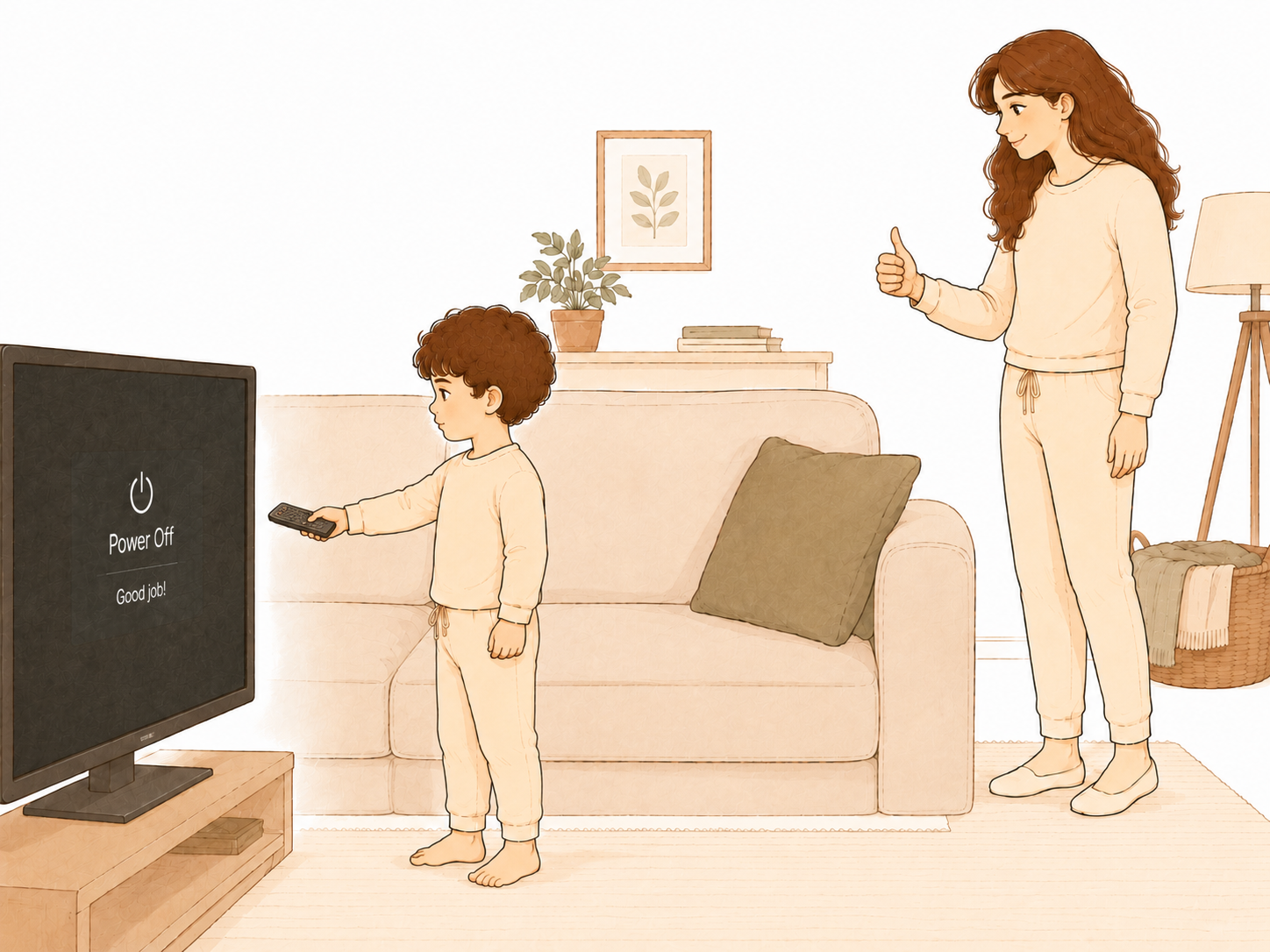
The screen is going off. That is not negotiable. How it goes off is flexible.
"Do you want to turn it off yourself, or should I turn it off?"
Done honestly, they get to choose how, even though the ending isn't up for debate. Done as a trick, they see through it. Most children, given a real choice, will choose to do it themselves. That small act of ownership changes the transition from something done to them into something they participated in.
Step 5: Leave the screen room
Move bodies. A child standing next to a dark screen is one tap away from turning it back on. Move to the next room, sit at the dinner table, and change the physical environment entirely, not just the screen. The transition is complete when the child is in a different context.
What to say when screen time ends
| Situation | Don't say | Say instead |
|---|---|---|
| "Just one more episode" | "Fine, but that's the last one". | "That's not the plan. One more minute of this one, then we're done". |
| "It's not fair" | "Life isn't fair". | "I hear you. Dinner is ready". |
| "Five more minutes" | "Okay, five minutes". | "We did the warning. It's time". |
| Ignores you completely | Repeat louder | Walk to them, get to their level, make eye contact, say once |
| "You always do this" | Defend yourself | "Screens are done. Let's go eat". |
| Immediate meltdown | Explain why screens need to end | Say nothing. Give the body time to settle. Then move. |
Keep responses short. Once the transition starts, stop trying to persuade. Just complete the move.
What to do if it fails
If they ignore the warning completely:
Stop calling from another room. Walk to them. Get low: physical level, not looming. Make eye contact. Say once: "Screens are done. You can turn it off or I will". Wait ten seconds. If they don't move, turn it off calmly and say nothing further.
If they escalate immediately:
Your kid is too keyed up right now to hear reasons. Explaining why screens have to end now will not help. Say one thing: "I hear you. We're moving to dinner". Then move. Do not re-engage with the screen argument. Do not defend the decision.
If they grab the device back or try to turn it on again:
Take the device or move to a room without screens. Say once: "Screens are done for today. We can try again tomorrow". Do not repeat. Do not negotiate. The second attempt to re-engage the screen ends screen time for the session.
If they won't leave the room:
Say once: "We're going to the kitchen now". If they don't move, say: "I'm going to carry you to the kitchen". Then do it. Carry them calmly, settle them at the table, and continue with dinner as normally as possible. This is just how the transition gets finished today, not a punishment tacked on.
If this happens every single day regardless of warnings:
Look at the container. The most common cause of daily screen transition meltdowns is an unpredictable endpoint. The child never knows how many episodes or how much time they get, so they always resist in case this is the time they can negotiate more. Fix the container first.
Who this protocol is not for:
Children whose screen resistance is connected to significant anxiety, sensory seeking, ASD, or ADHD often need adapted approaches. The Bridge protocol and visual timers help some of these kids. Persistent or extreme behavior needs professional assessment, not a stronger protocol.
The parent habit to build
Implementation intention: Before any screen goes on, I name the container out loud: "One episode, then dinner".
This is the single highest-leverage habit for screen transitions. It costs ten seconds. It prevents the meltdown at the other end because the child knew from the start when it was ending.
One miss is fine. Two becomes the pattern: If yesterday's transition was chaos, today just set the container before the screen goes on. You don't have to nail all five steps on the second attempt. Set the container. The other steps follow more naturally once the endpoint is predictable.
Ready to install this, not just read it?
The Transitions Reset applies the Bridge protocol to the full screen transition loop: the container rules, the warning sequence, the choice scripts, the meltdown-at-the-endpoint protocol, and what to do when one parent holds the limit and the other gives five more minutes.
The article tells you what to do. The Reset installs it.
Join the waitlist for the Transitions Reset →